Image

Instituto de Productos Naturales y Agrobiología
A continuación se muestran las últimas novedades sobre investigaciones, eventos, actividades y descubrimientos que se llevan a cabo en el Instituto de Productos Naturales y Agrobiología.

Diseases caused by Leishmania spp. and Trypanosoma spp. parasites provoke thousands of annual deaths. The current treatments exhibit noticeable disadvantages such as low effectiveness, high cost, side-effects, and the occurrence of resistance. Thus, the search for new drugs is mandatory, and diversity-oriented synthesis appears as a useful tool to access libraries of small, structurally diverse, and potentially bioactive compounds in few steps. In this work, a battery of 10 new and highly substituted β-hydroxy-γ-lactones was straightforwardly synthesized from β,γ-unsaturated N-acyl oxazolidin-2-ones and evaluated against Leishmania amazonensis and Trypanosoma cruzi. Six of the compounds were found to exhibit antiparasitic activity against T. cruzi epimastigotes and/or L. amazonensis promastigotes, as well as against the amastigote forms of both parasites; among these, two compounds stood out against L. amazonensis, with selectivity indices (SI) higher than that of the reference drug. Furthermore, these two compounds appear to induce apoptosis-like cell death in L. amazonensis, as suggested by mechanistic studies. It is worth noting that the compound SAM-2 exhibited an SI four times higher than miltefosine, due to its lower toxicity compared to this drug, highlighting its potential as a promising candidate for the development of new therapies.
Delgado-Hernández, Samuel, Isabel M. Calero-Docina, Carlos J. Bethencourt-Estrella, Sergio J. Álvarez-Méndez, Atteneri López-Arencibia, Jacob Lorenzo-Morales, José E. Piñero

Acanthamoeba spp. are ubiquitous protozoa and the causative agents of severe human infections, including granulomatous amoebic encephalitis (GAE) and Acanthamoeba keratitis (AK). The lack of standardised and fully effective treatments highlights the urgent need for novel therapeutic agents. In this study, we evaluated the in vitro amoebicidal activity of 8 cyanoacrylamide derivatives (QOET) against three different strains of Acanthamoeba: A. castellanii Neff, A. griffini and A. polyphaga. Among the tested compounds, QOET-112 and 114 displayed the lowest IC50 values against both the trophozoite and cyst stages compared to the other derivatives. Furthermore, these compounds demonstrated low cytotoxicity against the murine macrophage cell line J774A.1. Analysis of the mode of action evidenced that both cyanoacrylamides triggered programmed cell death (PCD) and autophagy in A. griffini trophozoites. Additionally, these compounds induced severe cytoskeletal alterations, specifically characterised by the disorganisation and disruption of the actin and tubulin networks.
Rodríguez-Expósito, Rubén L.; Delgado-Hernández, Samuel; Sifaoui, Ines; Reyes-Batlle, María; Tejedor, David; Piñero, José E.; Lorenzo-Morales, Jacob
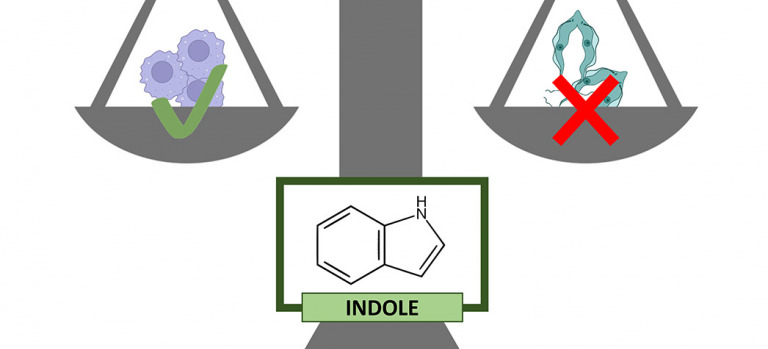
Chagas disease, caused by the protozoan Trypanosoma cruzi, remains a serious public health concern, particularly in Latin America, due to its high prevalence and the limited efficacy and safety of current treatments. To identify new potential therapeutic options, a library of 40 synthetic indole derivatives was screened for antiparasitic activity. The compounds were tested against both epimastigote and intracellular amastigote forms of T. cruzi using in vitro assays. While most of the molecules showed low or no activity, ten compounds exhibited promising effects with IC₅₀ values below 200 μM. The most active derivatives were further evaluated for cytotoxicity on mammalian cells. Among them, the compound I – 7b stood out with a selectivity index of 19.8 and was selected for further characterization. Subsequent assays revealed that this compound induced several cellular effects in the parasite, including ATP depletion, chromatin condensation, plasma membrane damage, reactive oxygen species (ROS) accumulation, and disruption of mitochondrial membrane potential (ΔΨm). These findings suggest that certain indole-based compounds may serve as promising scaffolds for the development of novel therapies against T. cruzi, contributing to the advancement of global health efforts targeting neglected tropical diseases.
C. J. Bethencourt-Estrella, A. López-Arencibia, R. Diana-Rivero, I. Sifaoui, I. M. Calero-Docina, D. Tejedor, J. Lorenzo Morales, J. E. Piñero
El blog del IPNA recoge artículos de divulgación sobre los diversos proyectos de investigación desarrollados en el centro, avances en la ciencia y otros temas de interés sobre cultura científica.